An AI agent can write an excellent customer response and still send the request to the wrong team. It can explain a refund policy clearly and still recommend an action the customer is not authorized to take.
These failures expose a distinction that matters when building agents: producing useful language and choosing a reliable next step are different engineering problems.
Jev addresses the second problem. Introduced by TypeSafe AI on September 15, 2026, it evaluates supplied context against defined questions and returns structured decisions with probabilities. Vercel’s launch coverage
The interesting question is where that specialization earns its place. To answer it, we need to understand the interface, compare it fairly with existing approaches, and examine the evidence behind the launch claims.
Research note: Sources were checked on September 21, 2026. Examples and calculations are illustrative; this article does not report an independent Jev benchmark.
What Jev actually does
Jev’s interface starts with state: the information available to your application. That could include a customer message, an account record, a policy, or the results of an earlier tool call. Developers supply typed questions about that state, and Jev returns answers the application can use in its logic. TypeSafe introduction
Consider this customer message:
“I cannot access my account, and I need last month’s invoices before our finance team closes the books today.”
A workflow might need to establish which problem should be addressed first, whether the request is time-sensitive, and whether more information is needed. None of those outputs requires a paragraph.
TypeSafe exposes three primitives:
| Primitive | What it returns | Example question |
|---|---|---|
| Choice | A selected option, probabilities across the options, and confidence | Which queue should own the next step: account access, billing, or manual triage? |
| Score | A position on an ordered rubric, probabilities across its levels, and confidence | How severe is the reported disruption? |
| Noul | A number from 0 to 1 representing the probability that the answer is yes | Does the customer specify a deadline? |
These are the native API names. Vercel’s AI SDK calls the yes/no question type Boolean. TypeSafe primitives, Vercel’s output guidance
For a Choice question, the selected option is the one with the highest probability. TypeSafe recommends including an alternative such as “other” when the listed choices may not cover every input. That matters in our example: a request can involve both account access and billing. The application must define what “own the next step” means. Choice reference
The quality of the question and its options remains part of the engineering work.
What “System One” means
TypeSafe calls Jev its first System One Model, taking inspiration from Daniel Kahneman’s fast/slow thinking distinction. It describes Reinforcement Learning for Calibrated Decisions (RLCD) and parallel sampling as foundations of the system. TypeSafe’s launch announcement
For developers, the practical feature is that multiple questions can be evaluated against the same state in one request. TypeSafe says those questions are evaluated independently and in parallel. TypeSafe introduction
There is a dependency boundary. A question cannot consume another question’s answer inside that request. If the first decision determines which records to retrieve, a later decision using those records needs a subsequent request. Question dependencies
This makes workflow design important. Batching independent judgments can remove repeated calls; it cannot remove the need to collect missing evidence.
How is this different from an LLM returning JSON?
Modern LLMs already support structured decisions. A fair comparison must acknowledge that.
OpenAI’s Structured Outputs, introduced in 2024, uses constrained decoding to produce responses matching supported developer-defined JSON schemas, subject to documented conditions such as refusals and interrupted generation. Developers do not necessarily need to extract a decision from free-form prose. OpenAI also explicitly distinguishes schema adherence from correctness of the values inside the response. OpenAI’s Structured Outputs announcement
Jev’s proposed advantage is its specialization: TypeSafe says it optimizes for probabilistic decisions and generates its outputs in parallel, giving up general string generation. Whether that delivers a useful advantage depends on the task and the baseline. TypeSafe’s launch announcement
For an engineering team, I would frame the comparison this way:
| Work required | Approaches worth comparing |
|---|---|
| Enforce a precise rule over trusted records | Ordinary application code |
| Assign messages to a stable, well-labeled taxonomy | A conventional classifier, a small LLM, and Jev |
| Interpret changing instructions and choose among defined outcomes | Jev and an LLM with structured outputs |
| Investigate a problem requiring several evidence-gathering steps | An orchestrated workflow with a reasoning model and tools |
| Draft an explanation or customer reply | A generative model |
These are candidate comparisons, not performance rankings. A new component should earn its place against the implementation you would realistically deploy, including a simple classifier where one is sufficient.
Where Jev fits inside an agent
Jev can sit at a bounded decision point: choosing a handler, assessing supplied evidence, or deciding whether a proposed answer meets a defined criterion. Application code remains responsible for permissions and tool execution. This division is also central to Vercel’s agent guidance. Jev in an agent loop
Here is an illustrative support workflow:
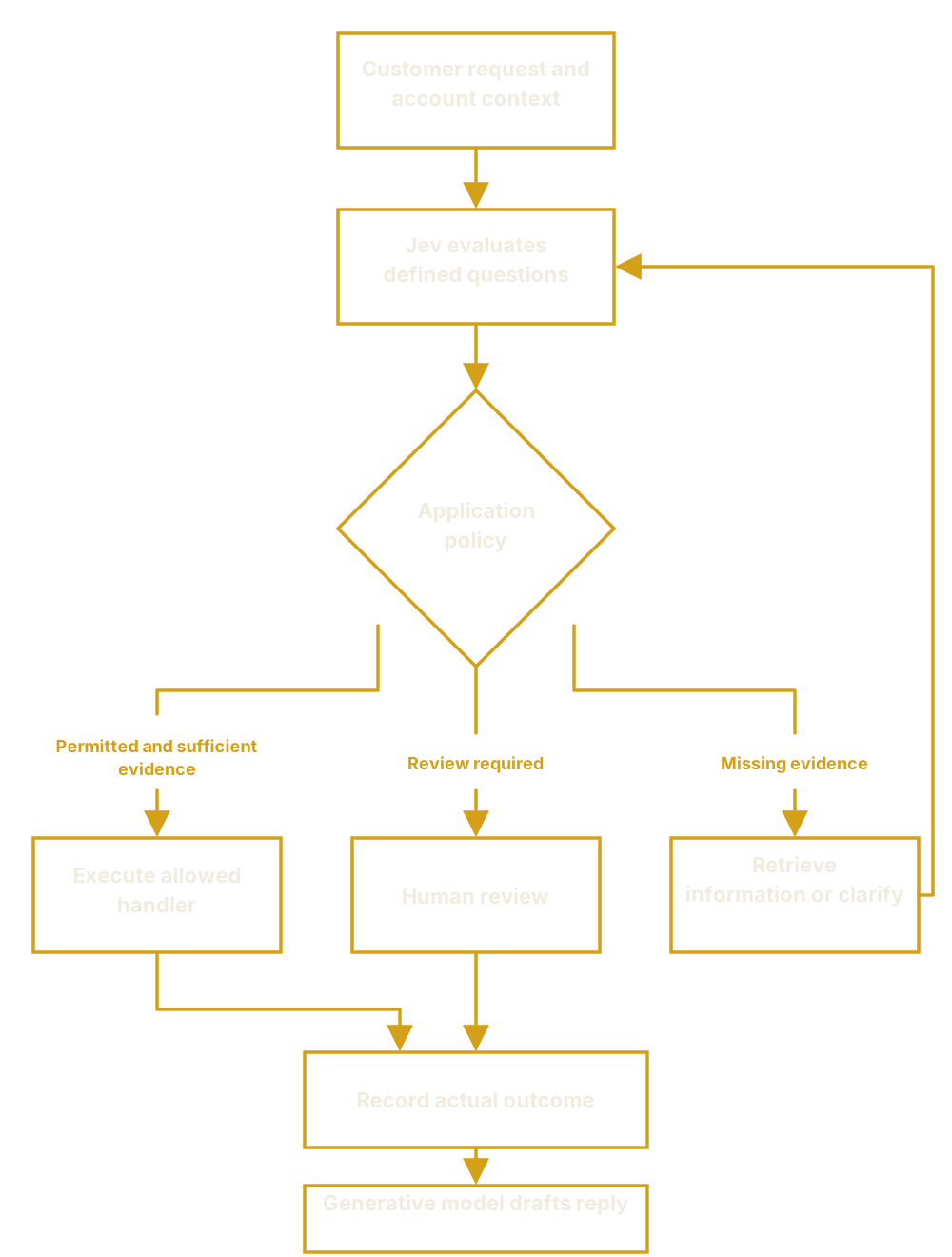
The design does not require an LLM call before Jev. If the application already has the relevant message and records, it can supply them directly.
Return to the locked-account example. The routing question asks which team should handle the immediate blocker. A separate question asks whether the message contains a deadline. Application code can combine those answers to place the request in an urgent account-recovery queue while preserving the invoice requirement.
The handler must still verify identity before exposing invoices. A strong prediction that the user needs an invoice says nothing about whether they may access that invoice.
After the handler runs, the reply should reflect its actual result. If verification failed, the generative model should receive that failure as evidence. A proposed action and a completed action are different states.
For a voice agent, the same design could evaluate a transcript and current session state. That is an architectural possibility, not evidence of speech-processing capability or a measured conversational latency improvement.
Probability, confidence, and score measure different things
A useful interface can still be misused if the application treats every number as “how correct the model is.”
A Choice probability assigns probability to a particular option. TypeSafe’s separate confidence statistic summarizes how concentrated the distribution is. It is not interchangeable with the selected option’s probability, and a concentrated distribution can still accompany a wrong answer. TypeSafe confidence documentation
A Noul value answers a yes/no proposition. A value close to zero strongly favors “no”; a value near 0.5 indicates uncertainty between the two outcomes. There is no separate confidence field for Noul. Noul reference
A Score is a probability-weighted average of ordered level indices. The native API accepts two to ten descriptive levels, numbered from zero. A score of 1.6 on a three-level rubric lies between levels 1 and 2. Rescaling it to 80 out of 100 does not make it an 80% probability of success. Score reference
Calibration adds another requirement: predicted probabilities should correspond to observed frequencies across many comparable cases. If an event repeatedly receives an estimated probability around 0.8, a well-calibrated system should see that event occur roughly 80% of the time in that group. Guo and colleagues’ ICML research explains why neural-network confidence needs evaluation; it is background research, not a study of Jev. On Calibration of Modern Neural Networks
Vercel accordingly recommends selecting thresholds using labeled application data and measuring both mistakes and review volume. Probability and threshold guidance
For our support example, the useful question is how often automatic routing reaches the right handler without losing the invoice request. A higher threshold is valuable only if its reduction in mistakes justifies the additional cases sent for review.
What the performance claims establish
TypeSafe advertises Jev as 193.6× faster and 444.6× cheaper on its System One workflow evaluations. Its launch announcement says those gains are likely toward the higher end of real-world improvements. It also notes that the LLM comparison wrapper requests probabilities, which can be slower and more expensive than requesting decisions alone. TypeSafe’s benchmark discussion
The evaluation site covers four workflows: security incidents, agent-trace observability, invoice processing, and customer service. Its reference answers are derived from the responses of two large models, rather than independently established human ground truth. The evaluation assumes the workflow code is correct, and comparison models use their providers’ default reasoning settings. TypeSafe workflow evaluations
My reading is that this supports a promising hypothesis about a particular workload: decomposed, probabilistic judgments composed in code. It does not establish a universal speed advantage or prove that the resulting business actions are correct.
Two additional comparisons would be useful for a deployment decision. First, compare with the cheapest existing model that meets the required quality, including a label-only output if probabilities are unnecessary. Second, measure the complete workflow. A much faster classification call may make little difference when database access or human review dominates completion time.
The benchmark deserves investigation. The headline multiplier should not become a forecast for your application.
Pricing: distinguish the advertised rate from the promotion
As of September 21, 2026, TypeSafe advertises $42 per billion input tokens, equivalent to $0.042 per million. Its launch announcement says output tokens are free. TypeSafe pricing, Launch pricing details
Vercel’s current Jev listing separately shows free input and output under promotional pricing ending September 25, 2026. The same page lists a 32K context window. Those are time-sensitive listing details, not permanent commercial terms. Vercel AI Gateway model listing
An illustrative calculation puts the advertised input rate in context. Assume one million requests, each with 2,000 total billable input tokens, including the relevant state and questions:
1,000,000 × 2,000 = 2 billion input tokens. At $42 per billion, input inference costs $84.
That figure excludes retries, other model calls, retrieval, infrastructure, and review effort. It also assumes the advertised rate applies to the chosen route.
My recommendation is to track cost per correctly completed workflow alongside token cost. Saving on inference is useful; a routing error that creates several minutes of support work can consume those savings quickly.
Early adoption is encouraging, but the denominator matters
On September 18, Vercel reported that nearly 13% of paid AI Gateway teams had used Jev within its first 24 hours on the gateway, making it the fastest-adopted model launch in that platform’s history. This is a Vercel-reported platform metric. Vercel adoption report
Cloudflare also lists Jev as a third-party model under typesafe/jev. Cloudflare model catalog
These are useful signs of access and early interest. They do not establish retention, industry-wide market share, or spending specifically on Jev. Given the current gateway promotion, usage by a paid team should not be read as evidence that the team paid for this model.
Typed decisions still need operational controls
TypeSafe’s homepage uses the phrase “Zero Hallucinations.” Its launch explanation ties that claim to constrained outputs and schema matching. That is a narrower claim than an assurance of factual correctness. TypeSafe homepage, Launch explanation
A model restricted to allow, deny, and review can still select the wrong valid option. Similarly, a classification based on stale account data can have the correct type and the wrong business consequence.
For the support workflow, I would record the input evidence reference, question definition, model version, returned distribution, policy version, selected handler, and eventual outcome. Retain only the customer data necessary to investigate failures.
That record supports specific debugging questions. Did the model misunderstand the message? Were the routing categories incomplete? Did account information change before execution? Did the handler fail after a correct assignment?
For a multi-tenant product, I would also scope the supplied context, permissions, and thresholds to the appropriate tenant. A globally strong routing score can conceal poor performance for one tenant’s terminology or one language.
These are design recommendations. The decision model supplies one input to the system; the application must make the resulting behavior inspectable and enforce its rules at execution time.
How I would evaluate Jev before adopting it
Start with one frequent, bounded decision where mistakes are visible and the result can be reversed. Vercel’s workload guidance recommends testing defined outcomes against representative cases and comparing with the existing implementation. When to use Jev
For the account-and-invoice workflow, I would use this evaluation:
- Define success at the workflow level. The customer reaches a handler that can resolve account access, the invoice requirement survives routing, and protected records remain inaccessible until verification succeeds.
- Label realistic difficult cases. Include mixed requests, missing account information, multilingual messages, and quoted instructions. Have reviewers resolve disagreements before using their labels as a reference.
- Compare equivalent implementations. Give Jev and the baseline the same evidence and measure the complete route, including fallback behavior. Keep a separate held-out set for the final comparison.
- Measure consequential errors. Track incorrect routing among automatically handled cases, review rate, completion time, and total cost. Break results down by tenant and request category.
- Test operational failures. Define what happens when evaluation times out, evidence is unavailable, or the selected handler fails. Start with shadow evaluation before granting the workflow authority to change customer state.
The release criterion should be a measurable improvement in this workflow. A lower model bill alone would not be sufficient.
Jev makes a concrete architectural proposition: use a specialized model for focused judgments, compose those judgments with explicit rules, and retain generative models where the application needs language or extended reasoning.
That proposition is worth testing. Its lasting value will depend on how reliably the complete system handles real requests, including the ambiguous ones that a clean demonstration leaves out.